Olive Intel – From Market Data to Market Decisions
Designing and shipping an AI reasoning layer that turns public olive oil data into actionable producer and buyer guidance
Olive Intel – From Market Data to Market Decisions
Designing and shipping an AI reasoning layer that turns public olive oil data into actionable producer and buyer guidance
Role
Product designer
Team
Myself and Claude Code
Year
2026
01.
Intro
I was building an olive oil business. I found a producer in Kalamata, designed the packaging, set up an online shop. Then I paused to focus on my job search.
The season I paused into was a paradox. The Kalamata region had a decent local harvest, but opening prices dropped from €10.20 to €7.85 per kilo as supply recovered across the Mediterranean. Good yield, collapsing prices. Without understanding what was driving that - Spain's harvest recovery, demand destruction from two years of record highs, global inventory pressure - the decision to push forward or wait was essentially a guess.
The signals were all in public data. Nobody had made them readable.
Olive Intel is the tool I built to make that guess a decision
olive-intel.ahmednegm86.workers.dev
I was building an olive oil business. I found a producer in Kalamata, designed the packaging, set up an online shop. Then I paused to focus on my job search.
The season I paused into was a paradox. The Kalamata region had a decent local harvest, but opening prices dropped from €10.20 to €7.85 per kilo as supply recovered across the Mediterranean. Good yield, collapsing prices. Without understanding what was driving that - Spain's harvest recovery, demand destruction from two years of record highs, global inventory pressure - the decision to push forward or wait was essentially a guess.
The signals were all in public data. Nobody had made them readable.
Olive Intel is the tool I built to make that guess a decision
olive-intel.ahmednegm86.workers.dev
01.
Intro
I was building an olive oil business. I found a producer in Kalamata, designed the packaging, set up an online shop. Then I paused to focus on my job search.
The season I paused into was a paradox. The Kalamata region had a decent local harvest, but opening prices dropped from €10.20 to €7.85 per kilo as supply recovered across the Mediterranean. Good yield, collapsing prices. Without understanding what was driving that - Spain's harvest recovery, demand destruction from two years of record highs, global inventory pressure - the decision to push forward or wait was essentially a guess.
The signals were all in public data. Nobody had made them readable.
Olive Intel is the tool I built to make that guess a decision
olive-intel.ahmednegm86.workers.dev
What I did
Product scoping and persona definition
Competitive landscape research
Information architecture
Wireframing and component design
AI layer design and prompt engineering
Full-stack build with Claude Code
What I did
Product scoping and persona definition
Competitive landscape research
Information architecture
Wireframing and component design
AI layer design and prompt engineering
Full-stack build with Claude Code
02.
Discovery
Two users, one dataset
Two distinct users needed different things from the same underlying data.
A market watcher - buyer, importer, trader - wants to know where prices are heading. They need macro signals, harvest forecasts, and a directional call they can act on.
A grower like Spiros, who owns 500 Koroneiki trees in Kalamata, wants to know what he will produce this season and when to sell. He needs a yield estimate, a revenue range, and a flag when input costs are rising.
Both personas share the same data. The connection between them is the insight - Spiros can look at the market direction and his yield estimate together and make a timing decision. That pairing is the product.
02.
Discovery
Two users, one dataset
Two distinct users needed different things from the same underlying data.
A market watcher - buyer, importer, trader - wants to know where prices are heading. They need macro signals, harvest forecasts, and a directional call they can act on.
A grower like Spiros, who owns 500 Koroneiki trees in Kalamata, wants to know what he will produce this season and when to sell. He needs a yield estimate, a revenue range, and a flag when input costs are rising.
Both personas share the same data. The connection between them is the insight - Spiros can look at the market direction and his yield estimate together and make a timing decision. That pairing is the product.
The competitive gap
No existing tool combines free, accessible market direction signals with a grower-facing yield calculator. The tools that exist are either paywalled B2B platforms, enterprise agri-tech requiring hardware sensors, or academic models not available to the public.
Procurement Resource / Tridge - paywalled B2B price data, no AI reasoning
TADIA.ai - research-grade price prediction, not consumer-facing
BeHTool / Farmonaut - enterprise hardware sensors, priced for large estates
OliveSuite - social networking for producers, no market intelligence
The 2025 price collapse proved the gap. Spain's supply recovery was visible in public IOC harvest data months before prices moved. Nobody synthesised it into a plain-language signal for small producers and independent buyers.
The competitive gap
No existing tool combines free, accessible market direction signals with a grower-facing yield calculator. The tools that exist are either paywalled B2B platforms, enterprise agri-tech requiring hardware sensors, or academic models not available to the public.
Procurement Resource / Tridge - paywalled B2B price data, no AI reasoning
TADIA.ai - research-grade price prediction, not consumer-facing
BeHTool / Farmonaut - enterprise hardware sensors, priced for large estates
OliveSuite - social networking for producers, no market intelligence
The 2025 price collapse proved the gap. Spain's supply recovery was visible in public IOC harvest data months before prices moved. Nobody synthesised it into a plain-language signal for small producers and independent buyers.
Why directional, not predictive
The 2025 price collapse was not a surprise in hindsight. Spain's +48% harvest recovery was visible in public IOC flowering data months before prices moved. EU consumption had fallen 22% over two prior years as consumers switched to alternatives. The signal was there. It just was not synthesised.
A tool claiming to predict €/kg with precision would be dishonest. A tool that reads direction and explains why is genuinely useful. This distinction shaped every AI prompt in the product.
Why directional, not predictive
The 2025 price collapse was not a surprise in hindsight. Spain's +48% harvest recovery was visible in public IOC flowering data months before prices moved. EU consumption had fallen 22% over two prior years as consumers switched to alternatives. The signal was there. It just was not synthesised.
A tool claiming to predict €/kg with precision would be dishonest. A tool that reads direction and explains why is genuinely useful. This distinction shaped every AI prompt in the product.
03.
Design
Information architecture — two sections, one tool
The dashboard splits into two distinct sections separated by a visual divider. The top half serves the market watcher. The bottom half serves Spiros. Both share the same underlying data and the same AI reasoning layer.
The top section follows a decision-first hierarchy - the most actionable signal appears first, with supporting data below it:
Market Signals ticker - scrolling macro events with AI-generated impact tags
Claude Market Outlook - SELL/HOLD/DELAY recommendation, Olive Market Pressure Index, directional stance, key drivers, key risks, plain-language summary
KPI strip - global price, Jaén spot, world production, Spain harvest
Price history chart and production by region
This order reflects a deliberate product decision: users should understand what to do within 10 seconds of landing on the page. The data exists to support the decision, not to precede it.
03.
Design
Information architecture — two sections, one tool
The dashboard splits into two distinct sections separated by a visual divider. The top half serves the market watcher. The bottom half serves Spiros. Both share the same underlying data and the same AI reasoning layer.
The top section follows a decision-first hierarchy - the most actionable signal appears first, with supporting data below it:
Market Signals ticker - scrolling macro events with AI-generated impact tags
Claude Market Outlook - SELL/HOLD/DELAY recommendation, Olive Market Pressure Index, directional stance, key drivers, key risks, plain-language summary
KPI strip - global price, Jaén spot, world production, Spain harvest
Price history chart and production by region
This order reflects a deliberate product decision: users should understand what to do within 10 seconds of landing on the page. The data exists to support the decision, not to precede it.
The AI layer as a design system
Claude Haiku 4.5 is the reasoning layer, not a black box. Every AI-generated element is marked with amber throughout the UI - so users always know what is data and what is Claude's interpretation. Semantic colours are locked and never overridden by brand choices:
Green - bullish / positive signal
Red - bearish / negative signal
Orange - margin pressure
Yellow - watch / uncertain
Zinc - neutral
This colour logic is a product decision about transparency, not just a visual choice.
The AI layer as a design system
Claude Haiku 4.5 is the reasoning layer, not a black box. Every AI-generated element is marked with amber throughout the UI - so users always know what is data and what is Claude's interpretation. Semantic colours are locked and never overridden by brand choices:
Green - bullish / positive signal
Red - bearish / negative signal
Orange - margin pressure
Yellow - watch / uncertain
Zinc - neutral
This colour logic is a product decision about transparency, not just a visual choice.
The Outlook Panel
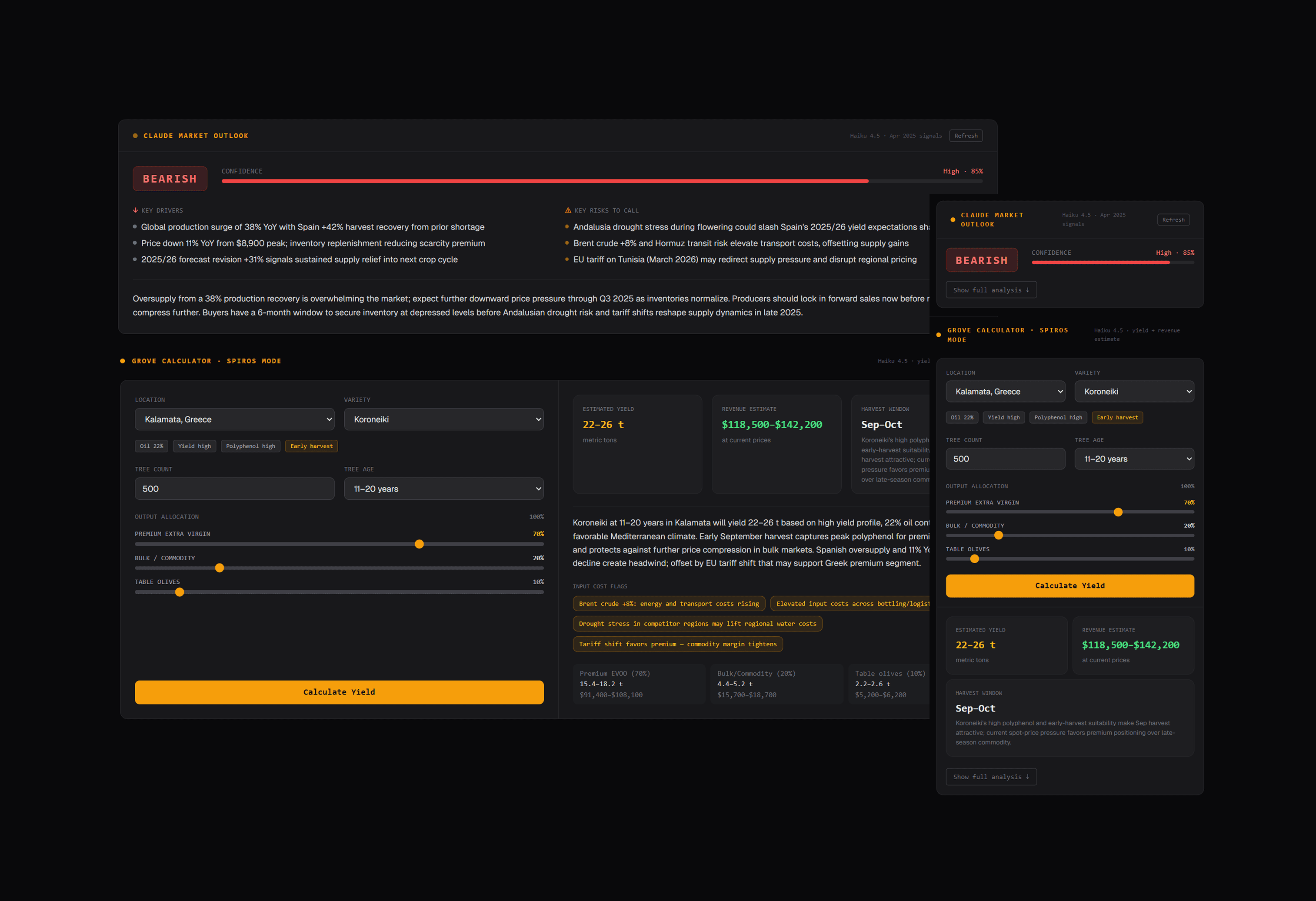
The Claude Market Outlook panel is the core feature. It takes all available signals - price data, production forecasts, harvest conditions, energy costs, geopolitical events - and produces a structured response:
Directional stance (BEARISH / BULLISH / NEUTRAL) with confidence level
Three key drivers and three key risks
Plain-language summary with an actionable call
The stance and confidence bar are the primary signal. Drivers and risks explain it. The summary synthesises everything. Each row answers "why?" for the row above.
The Outlook Panel
The Claude Market Outlook panel is the core feature. It takes all available signals - price data, production forecasts, harvest conditions, energy costs, geopolitical events - and produces a structured response:
Directional stance (BEARISH / BULLISH / NEUTRAL) with confidence level
Three key drivers and three key risks
Plain-language summary with an actionable call
The stance and confidence bar are the primary signal. Drivers and risks explain it. The summary synthesises everything. Each row answers "why?" for the row above.
The Grove Calculator
The grove calculator connects market signals to a specific grower's reality. Inputs include location, olive variety, tree count, tree age, and output allocation across three product types via sliders that auto-rebalance to 100%.
Claude takes those inputs alongside current market conditions and returns a yield range, revenue estimate, harvest timing recommendation, and input cost flags drawn from live ticker events. The output is specific to Spiros's grove, not generic to all producers.
Variety badges show oil content, yield profile, polyphenol level, and early harvest potential immediately on selection - giving growers the agronomic context they need to make the allocation decision.
The Grove Calculator
The grove calculator connects market signals to a specific grower's reality. Inputs include location, olive variety, tree count, tree age, and output allocation across three product types via sliders that auto-rebalance to 100%.
Claude takes those inputs alongside current market conditions and returns a yield range, revenue estimate, harvest timing recommendation, and input cost flags drawn from live ticker events. The output is specific to Spiros's grove, not generic to all producers.
Variety badges show oil content, yield profile, polyphenol level, and early harvest potential immediately on selection - giving growers the agronomic context they need to make the allocation decision.
Honest v1 scoping
Several things were cut deliberately.
The harvest stress map - a Mediterranean region view colour-coded by drought and supply conditions - was planned but excluded. The complexity of sourcing and normalising regional weather data was not worth the effort before the core value was validated.
Price and production data is hardcoded from verified sources (FRED, IOC) as of April 2026. The grove calculator uses Claude's training knowledge about regional climate conditions rather than live weather API calls. Both are documented clearly in the product and in the README.
These were product decisions, not technical limitations.
Honest v1 scoping
Several things were cut deliberately.
The harvest stress map - a Mediterranean region view colour-coded by drought and supply conditions - was planned but excluded. The complexity of sourcing and normalising regional weather data was not worth the effort before the core value was validated.
Price and production data is hardcoded from verified sources (FRED, IOC) as of April 2026. The grove calculator uses Claude's training knowledge about regional climate conditions rather than live weather API calls. Both are documented clearly in the product and in the README.
These were product decisions, not technical limitations.
04.
Impact
The tool is live at olive-intel.ahmednegm86.workers.dev
Built and deployed in one day using Claude Code - Anthropic's agentic coding tool - with a detailed context document as the briefing.
Stack: React + Vite · shadcn/ui · Recharts · Cloudflare Workers · Anthropic Claude Haiku 4.5
Architecture: A Cloudflare Worker sits between the React frontend and the Anthropic API, keeping the API key server-side and never exposed to the browser.
Three live AI components:
Market Signals ticker - Claude tags each event with impact type and one-line explanation
Claude Market Outlook - directional stance with confidence level, key drivers, key risks and plain-language summary
Grove Calculator - yield range, revenue estimate, harvest timing, input cost flags
Specific outputs for Spiros (500 mature Koroneiki trees, Kalamata):
Yield estimate: 22–26 tonnes
Revenue estimate: $118,500–$138,200 at current prices
Harvest timing: Sep–Oct, early harvest recommended for polyphenol premium
Input cost flags drawn from live ticker events
All generated in under 2 seconds
Cost per AI reasoning call: ~$0.003 (800 input + 400 output tokens at Haiku 4.5 rates). Prompt caching on system prompts cuts repeated call costs by ~90%.
The tool is live at olive-intel.ahmednegm86.workers.dev
Built and deployed in one day using Claude Code - Anthropic's agentic coding tool - with a detailed context document as the briefing.
Stack: React + Vite · shadcn/ui · Recharts · Cloudflare Workers · Anthropic Claude Haiku 4.5
Architecture: A Cloudflare Worker sits between the React frontend and the Anthropic API, keeping the API key server-side and never exposed to the browser.
Three live AI components:
Market Signals ticker - Claude tags each event with impact type and one-line explanation
Claude Market Outlook - directional stance with confidence level, key drivers, key risks and plain-language summary
Grove Calculator - yield range, revenue estimate, harvest timing, input cost flags
Specific outputs for Spiros (500 mature Koroneiki trees, Kalamata):
Yield estimate: 22–26 tonnes
Revenue estimate: $118,500–$138,200 at current prices
Harvest timing: Sep–Oct, early harvest recommended for polyphenol premium
Input cost flags drawn from live ticker events
All generated in under 2 seconds
Cost per AI reasoning call: ~$0.003 (800 input + 400 output tokens at Haiku 4.5 rates). Prompt caching on system prompts cuts repeated call costs by ~90%.
04.
Impact
The tool is live at olive-intel.ahmednegm86.workers.dev
Built and deployed in one day using Claude Code - Anthropic's agentic coding tool - with a detailed context document as the briefing.
Stack: React + Vite · shadcn/ui · Recharts · Cloudflare Workers · Anthropic Claude Haiku 4.5
Architecture: A Cloudflare Worker sits between the React frontend and the Anthropic API, keeping the API key server-side and never exposed to the browser.
Three live AI components:
Market Signals ticker - Claude tags each event with impact type and one-line explanation
Claude Market Outlook - directional stance with confidence level, key drivers, key risks and plain-language summary
Grove Calculator - yield range, revenue estimate, harvest timing, input cost flags
Specific outputs for Spiros (500 mature Koroneiki trees, Kalamata):
Yield estimate: 22–26 tonnes
Revenue estimate: $118,500–$138,200 at current prices
Harvest timing: Sep–Oct, early harvest recommended for polyphenol premium
Input cost flags drawn from live ticker events
All generated in under 2 seconds
Cost per AI reasoning call: ~$0.003 (800 input + 400 output tokens at Haiku 4.5 rates). Prompt caching on system prompts cuts repeated call costs by ~90%.
05.
Learnings
Honest scoping is a product skill.
Deciding what not to build - and being transparent about it - is as important as deciding what to include. The weather integration, harvest map, and feedback loop are planned for v2. Documenting that clearly is part of the product, not an apology for it.
AI fluency is knowing where reasoning adds value
The decision to build a directional tool rather than a price predictor was the most important product decision in the project. A tool claiming to predict €/kg with precision would be dishonest. A tool that reads direction and explains why is genuinely useful. That distinction shaped every AI prompt.
Context is infrastructure
The briefing document written before any code was written shaped every architectural and design decision Claude Code made. Investing in context before execution produced better results than iterating without it. The document captured personas, data sources, component structure, design system logic, AI layer philosophy, and v1 scope boundaries.
Building something real changes what you learn.
This project existed because the problem was real, the data was real, and the decision it supports was one I actually faced. That specificity produced a more focused product than any hypothetical brief would have. The OLEO brand, the Kalamata producer, the 2025 harvest paradox - these were not invented for a portfolio piece.
05.
Learnings
Honest scoping is a product skill.
Deciding what not to build - and being transparent about it - is as important as deciding what to include. The weather integration, harvest map, and feedback loop are planned for v2. Documenting that clearly is part of the product, not an apology for it.
AI fluency is knowing where reasoning adds value
The decision to build a directional tool rather than a price predictor was the most important product decision in the project. A tool claiming to predict €/kg with precision would be dishonest. A tool that reads direction and explains why is genuinely useful. That distinction shaped every AI prompt.
Context is infrastructure
The briefing document written before any code was written shaped every architectural and design decision Claude Code made. Investing in context before execution produced better results than iterating without it. The document captured personas, data sources, component structure, design system logic, AI layer philosophy, and v1 scope boundaries.
Building something real changes what you learn.
This project existed because the problem was real, the data was real, and the decision it supports was one I actually faced. That specificity produced a more focused product than any hypothetical brief would have. The OLEO brand, the Kalamata producer, the 2025 harvest paradox - these were not invented for a portfolio piece.
Thank you for reading